

When the Link Goes Dark: How Edge AI Is Changing Military Drones
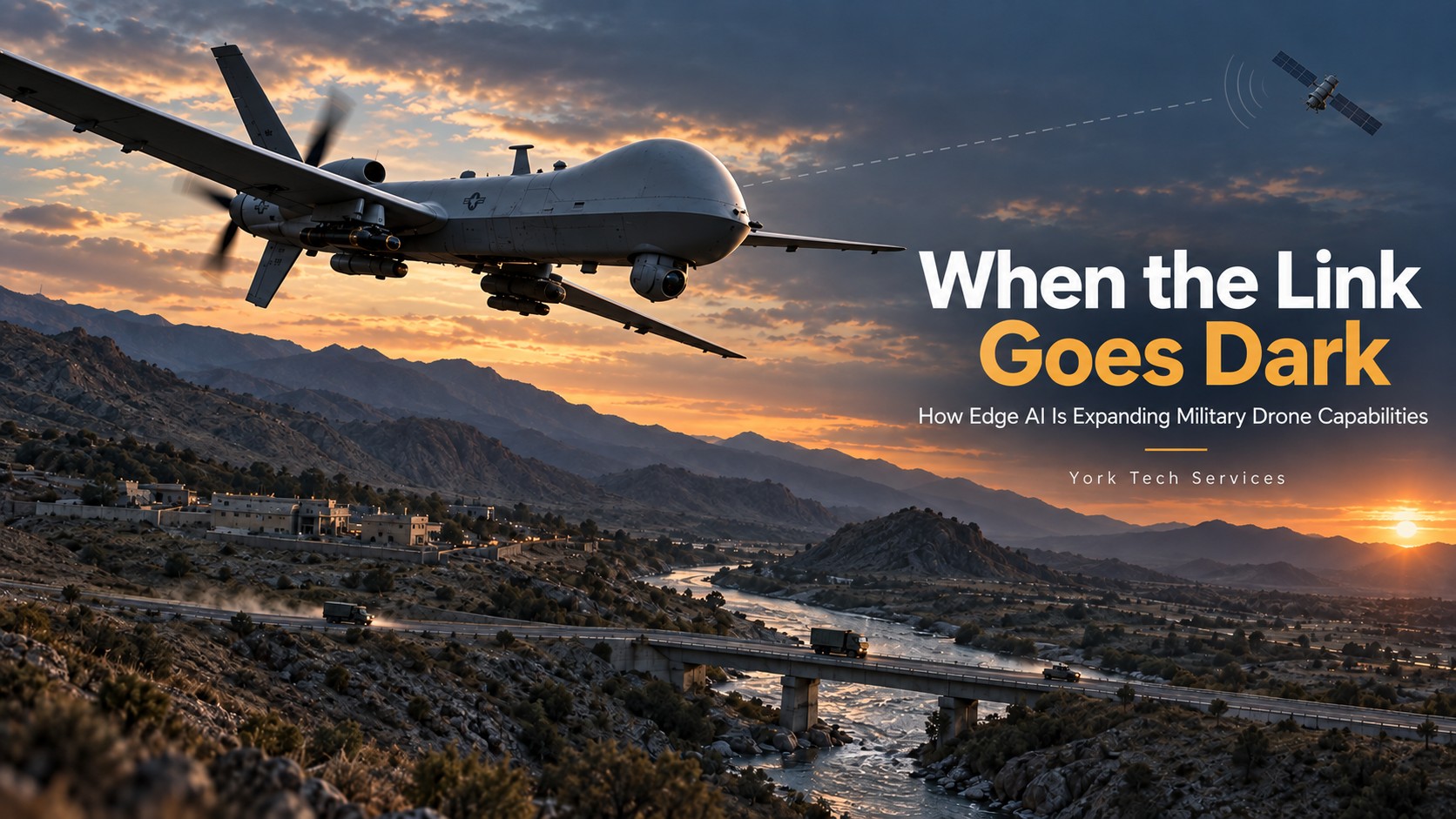
Most remotely operated drones depend on a steady connection to the person controlling them. Video travels back to the operator, commands travel to the aircraft, and satellite navigation helps keep the drone on course. Break those links and the aircraft can quickly lose much of its usefulness.
Electronic warfare is built around exploiting that dependence. Radio communications can be jammed, satellite-navigation signals can be disrupted or spoofed, and a drone operating in a contested area may lose its connection entirely. The war between Russia and Ukraine has provided years of examples, with both sides deploying electronic-warfare systems and repeatedly modifying their drones as new countermeasures appear.
One response is to give the aircraft more computing capability of its own. Instead of functioning mainly as a flying camera that sends information elsewhere for processing, a drone can carry hardware capable of analyzing sensor data directly onboard. Computer vision can identify objects in a camera feed, navigation software can work with local sensor information, and portions of a mission can continue even when communication with another computer becomes unreliable.
This type of local processing is usually called edge computing or edge AI. Military drones happen to be one of the more demanding places to test it because losing connectivity may be expected rather than unusual.
Putting More Computing Power on the Aircraft
One company working in this area is Scaleout Systems, a Swedish machine-learning company that grew out of research at Uppsala University. Its work includes distributed machine learning, edge computing, and federated learning, where separate computers can contribute to improving an AI model without continuously sending all of their raw information to one central system.
Uppsala University says Scaleout's FEDAIR project has been investigating federated learning across distributed drones and sensors.
Scaleout has also worked with BAE Systems Bofors on ALMA, the Affordable Loitering Modular Ammunition project. Reporting by Ars Technica describes demonstrations in which relatively small AI models were run directly on drone hardware. The onboard system was capable of processing camera information, detecting and geolocating potential targets, and prioritizing them according to predefined mission parameters.
Running this kind of software on an aircraft presents a very different engineering problem from running AI in a data center. Weight matters. Power consumption matters. Heat matters. The computer also has to fit inside an aircraft that may already be carrying batteries, radios, sensors, cameras, and other equipment.
NVIDIA's Jetson platform is built for this kind of workload. The Jetson Orin Nano Super Developer Kit is rated at up to 67 TOPS of AI performance. TOPS means trillions of operations per second, a common measurement used for AI processors. NVIDIA lists power modes between 7 and 25 watts for the platform.
This is not a rack full of GPU servers squeezed into an aircraft. It is a compact embedded computer designed to operate inside robots, cameras, machines, and other devices.
That amount of computing power in a small package changes what engineers can place directly on the aircraft.
Giving a Camera Some Understanding of What It Sees
Computer vision is one of the technologies making these systems possible.
A normal camera records images. Computer-vision software analyzes those images and tries to identify useful patterns inside them. Depending on the model, the software might detect a vehicle, person, structure, or another object, determine approximately where it appears in the image, and assign a confidence score to its classification.
The same general technology is already used commercially. Manufacturing systems inspect products for defects, warehouse robots identify objects, traffic systems analyze vehicles, and autonomous equipment uses cameras as one source of information about its surroundings.
It is also important not to give the software more credit than it deserves. An object-detection model does not understand a truck, building, or person in the same sense that a human does. It has been trained to recognize statistical patterns in data and associate those patterns with classifications. Lighting, weather, image quality, camouflage, unfamiliar objects, bad training data, or deliberate attempts to fool the model can affect its results.
That limitation becomes much more serious when computer vision is used for military purposes.
On a drone, image processing can contribute to reconnaissance, navigation, tracking, and target recognition. If every camera frame has to cross a radio link before a remote computer can analyze it, those functions depend heavily on keeping that link alive. If the aircraft can process the images locally, losing the connection does not automatically eliminate its ability to use the camera.
Autonomy can also mean several different things. A drone may stabilize itself automatically, follow a route without manual steering, recognize objects with computer vision, track an object selected by an operator, or perform parts of a mission after losing communications. Those capabilities can all involve automation or autonomy, but they are not equivalent to allowing software to independently decide who or what should be attacked.
Edge AI Without the Cloud
Most consumer AI services rely heavily on cloud computing. A phone or computer sends information across the internet, servers in a data center perform the processing, and the result is returned to the user.
Edge computing moves some of that work closer to where the information originates. A drone's camera can capture an image and an onboard processor can analyze it immediately without sending the entire video feed somewhere else first.
This can reduce network traffic and response time while allowing equipment to perform some tasks without a reliable connection. The same approach has applications outside military systems. A robot inspecting a damaged building may lose connectivity. Mining or industrial equipment may operate in areas with poor cellular coverage. Machinery on a factory floor may need to react faster than a round trip to a cloud server allows.
Spacecraft deal with another version of the same problem. Bandwidth is limited, and communication delays become increasingly important as a spacecraft travels farther from Earth. Processing sensor information onboard can allow a spacecraft to decide which data is worth transmitting rather than sending everything back for analysis.
Training sophisticated AI models can still require enormous computing systems. Running an already-trained model, usually called inference, is a different workload and can often be done on much smaller hardware. Improvements in compact GPUs and dedicated AI processors are making that possible on more devices.
Designing for a Network That May Disappear
Scaleout has also tested distributed computing with the Swedish Air Force. According to Ars Technica, a forward-deployed computing node continued performing AI inference and active-learning tasks after its connection to a central node was lost. When communications returned, locally generated model information could be shared again.
That approach does not assume that every aircraft, vehicle, sensor, or computer will remain connected at all times. Each part of the system can retain some ability to operate locally.
Federated learning extends the idea. Rather than gathering all raw data in a central location before updating an AI model, multiple systems can perform work locally and later exchange selected model information. Uppsala University's description of Scaleout's research lists secure edge computation, network efficiency, system resilience, and decentralized machine learning among the technical problems being studied.
Scaleout has also participated in NATO's DIANA technology accelerator. DIANA connects companies working on dual-use technologies with testing facilities, accelerator sites, and potential users. Participation in the program does not mean that a particular technology has been purchased or deployed by NATO forces.
When the Software Is Connected to a Weapon
The ALMA demonstration brings computer vision and autonomous navigation into a much more consequential setting.
Ars Technica reported that the system demonstrated onboard detection, identification, geolocation, and prioritization of potential targets. A human operator was still involved. The operator had to verify the primary target and authorize the drone before it proceeded with the autonomous portion of its approach.
Ars updated its report on September 22, 2026, specifically to clarify the human operator's role.
That arrangement illustrates why descriptions such as "fully autonomous drone" can be misleading. The aircraft can have considerable autonomy during flight without being given unlimited authority over the use of force. One part of a mission may be automated while another remains under human control.
The point at which a machine moves from helping a person make a decision to making a lethal decision itself is where technical capability, military policy, ethics, and law begin to collide.
Why Human Authority Over Lethal Force Matters
Computer vision can process images faster than a human and autonomous navigation can continue working when a radio link disappears. Neither capability makes software legally or morally accountable for what happens afterward.
A machine can classify an object according to a model. It cannot accept legal responsibility if the classification was wrong.
A human commander or operator may have information the model does not have. The situation around a target may have changed. Civilians may have entered the area. A person may be surrendering, wounded, or otherwise protected under the law of armed conflict. Intelligence used to plan the operation may no longer be current. A confidence score from an object-detection model does not resolve those questions.
International humanitarian law places obligations on the people who plan, authorize, and conduct attacks. Those obligations include rules dealing with distinction between military and civilian targets, proportionality, and precautions intended to reduce civilian harm. Responsibility for complying with those rules cannot simply be transferred to an algorithm.
Keeping human authority in the lethal decision chain also creates an identifiable point of accountability. Someone has to understand the system's limitations, determine whether its use is lawful under the circumstances, and remain responsible for the decision to employ force.
The United States Department of Defense addresses this directly in Directive 3000.09, "Autonomy in Weapon Systems." The directive states that autonomous and semi-autonomous weapons are to be designed so commanders and operators can exercise appropriate levels of human judgment over the use of force. It also requires testing, legal review, training, understandable human-machine interfaces, and procedures that allow trained operators to activate and deactivate autonomous functions.
The wording is important. "Appropriate levels of human judgment" does not necessarily mean that a person must manually approve every individual engagement. Some defensive weapon systems, for example, may have to react faster than a human could reasonably identify an incoming threat and press a button.
There is also no worldwide treaty currently establishing a simple rule that a human must personally authorize every lethal action by an autonomous weapon.
A January 2026 Congressional Research Service report noted that there were no domestic or international legal prohibitions on the development of lethal autonomous weapon systems. Existing international humanitarian law still applies to their use, and individual countries may impose additional policies and restrictions on their own forces.
Countries bound by Article 36 of Additional Protocol I to the Geneva Conventions also have an obligation to review new weapons, means, and methods of warfare to determine whether their expected use would violate applicable international law. That requirement applies to the legality of the weapon and its expected use. It is not itself a universal requirement that a human approve every individual engagement.
International negotiations are still underway. The United Nations Group of Governmental Experts on lethal autonomous weapon systems met again from August 31 through September 4, 2026. On August 25, the UN Secretary-General and the president of the International Committee of the Red Cross renewed their call for new international rules governing autonomous weapons and preserving human control over the use of lethal force.
The technology is therefore moving in an area where existing law already applies, military policies add additional controls, and governments have not yet agreed on a dedicated international treaty governing exactly how much autonomy lethal systems should be allowed to have.
Electronic Warfare Has Accelerated the Engineering
The Russia-Ukraine war has become one of the most extensively observed examples of drones operating alongside large-scale electronic warfare.
Russian and Ukrainian forces have both used communications jamming and other electronic-warfare techniques. When one side develops an effective way to interfere with a drone, the other may change frequencies, modify antennas, alter communications equipment, use another navigation method, or move additional processing onto the aircraft.
Satellite navigation is one part of the problem. A drone that depends heavily on GPS or another Global Navigation Satellite System can have difficulty navigating when those signals are jammed or spoofed. Engineers have several possible alternatives, including inertial navigation, visual navigation, terrain matching, specialized antennas, and combinations of multiple sensors.
Not every solution depends on artificial intelligence. Fiber-optic drones are one of the more unusual examples. Rather than relying on a conventional radio connection, these systems trail a thin fiber-optic cable that maintains the communications link between the operator and the aircraft. That makes ordinary radio-frequency jamming much less effective against the control connection.
Other designs are moving in the opposite direction by reducing the amount of communication the aircraft needs.
Russia has continued modifying the satellite-navigation equipment used on its Geran family of one-way attack drones. CSIS has documented changing antenna configurations intended to improve resilience against Ukrainian electronic warfare.
Ukrainian developers have also experimented with onboard processing, automatic target recognition, and autonomous navigation intended to reduce dependence on vulnerable navigation and communication links. CSIS has cautioned that many of these systems represent partial autonomy rather than drones independently handling the entire process of locating, selecting, and attacking targets.
The conflict provides a useful engineering example without requiring either side to be treated as technologically superior or morally preferable. Electronic warfare produces a countermeasure, the opposing system is modified, and another countermeasure follows. Sometimes the answer is better software. Sometimes it is a different antenna or frequency. Sometimes the answer is a spool of fiber-optic cable.
Small Computers Can Now Do Quite a Lot
It is easy to focus on the aircraft and overlook how much of this development depends on improvements in compact computing.
An edge computer does not have to reproduce an entire cloud data center. It only needs enough performance to run the particular software required by the machine carrying it. As processors become smaller and more power-efficient, more of that work can happen directly on the device.
Robots can perform object recognition locally. Cameras can analyze footage without continuously uploading it. Vehicles can interpret sensor information with very little network delay. Remote machinery can continue performing some tasks after losing communications. Satellites can process information before deciding what needs to be transmitted back to Earth.
Military drones place these technologies in an unusually harsh environment because lost connectivity may be deliberate rather than accidental. The same engineering principles can still be useful anywhere a machine needs to keep functioning when a network connection becomes unreliable.
A modern drone can now carry enough computing power to analyze video, recognize objects, estimate its position, and continue performing some tasks after its connection to an operator disappears. Capabilities that once depended much more heavily on remote computers and constant communications are gradually moving onto the aircraft itself.
The difficult part comes when those technical capabilities are connected to lethal force. Computers can assist with navigation, recognition, tracking, and enormous amounts of information processing. Legal responsibility still belongs to people.
For now, the technology and the rules governing it are developing at the same time.
Sources
- Ars Technica: Small AI models let drones autonomously identify and attack battlefield targets
- NVIDIA: Jetson Orin Nano Super Developer Kit
- Uppsala University: Scaleout Systems: Advancing Distributed Machine Learning
- Center for Strategic and International Studies: Ukraine's Future Vision and Current Capabilities for Waging AI-Enabled Autonomous Warfare
- Center for Strategic and International Studies: Lessons from the Ukraine Conflict: Modern Warfare in the Age of Autonomy, Information, and Resilience
- Center for Strategic and International Studies: From Shahed to Geran: How Russia Continues to Reinvent the One-Way Attack Drone
- U.S. Department of Defense: DoD Directive 3000.09: Autonomy in Weapon Systems
- Congressional Research Service, updated January 6, 2026: Defense Primer: Emerging Technologies
- International Committee of the Red Cross: Article 36, Additional Protocol I: New Weapons
- United Nations Office for Disarmament Affairs: 2026 Group of Governmental Experts on Lethal Autonomous Weapons Systems
- International Committee of the Red Cross, August 25, 2026: Renewed call from UN Secretary-General and ICRC President to adopt rules on autonomous weapon systems
Key Takeaways
- Edge AI lets drones process sensor data, recognize objects, and continue some tasks without a constant connection to a remote computer.
- Electronic warfare is accelerating the move toward local processing, alternative navigation, and resilient distributed systems.
- Automation, autonomous flight, target recognition, and autonomous lethal decision-making are different capabilities and should not be treated as interchangeable.
- Human responsibility for lawful use of force remains essential while the technology and international rules continue to develop.